By clicking “Accept,” you agree to the use of cookies and similar technologies on your device as set forth in our Cookie Policy and our Privacy Policy. Please note that certain cookies are essential for this website to function properly and do not require user consent to be deployed.
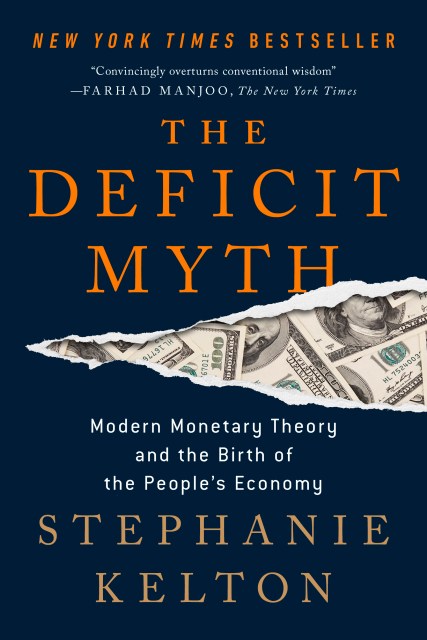
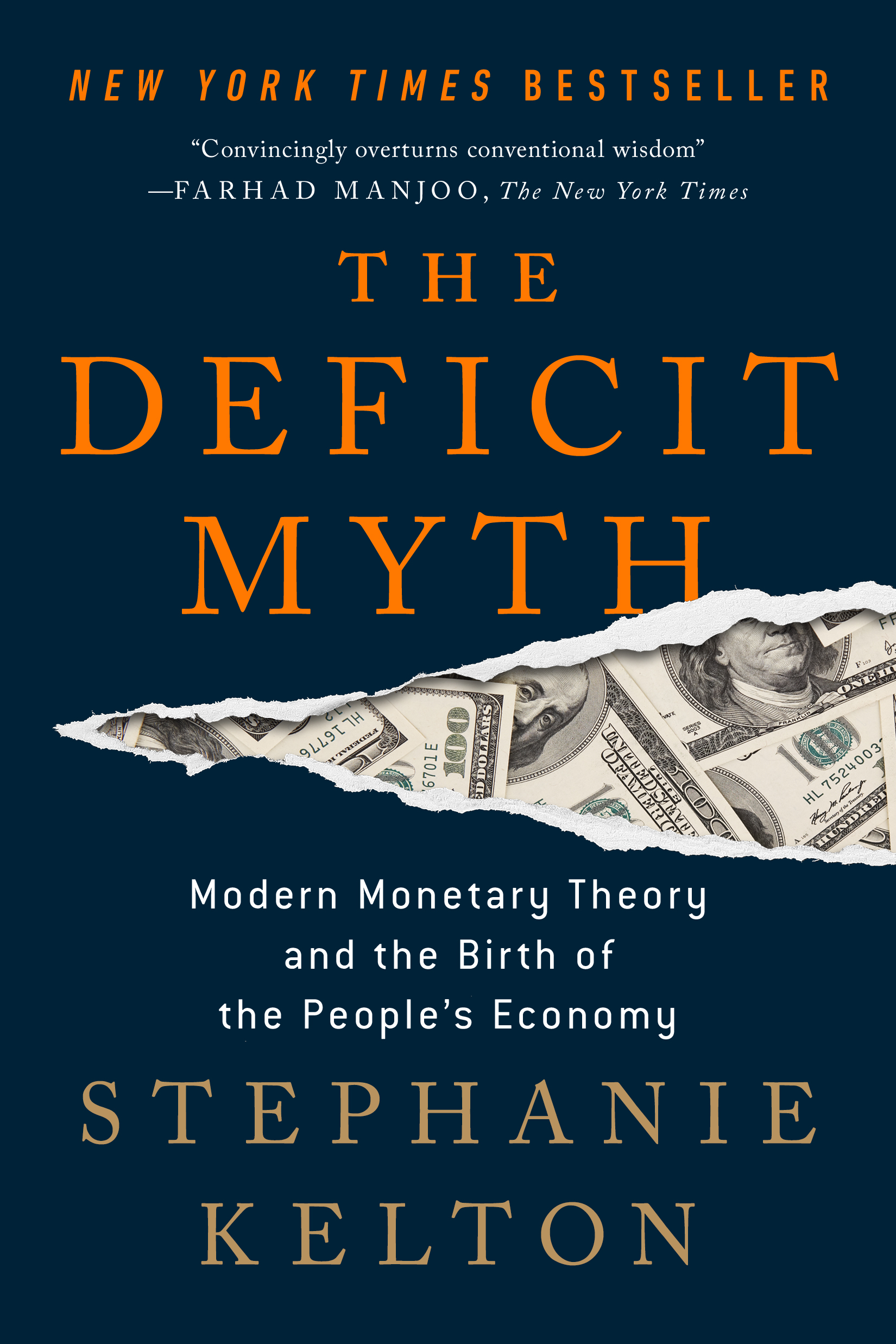
The Deficit Myth
Modern Monetary Theory and the Birth of the People's Economy
Contributors
Formats and Prices
- On Sale
- Mar 9, 2021
- Page Count
- 352 pages
- Publisher
- PublicAffairs
- ISBN-13
- 9781541736191
Price
$21.99Price
$28.99 CADFormat
Format:
- Trade Paperback $21.99 $28.99 CAD
- ebook $12.99 $16.99 CAD
- Audiobook Download (Unabridged)
Buy from Other Retailers:
A “clear and vigorously written book” (Foreign Affairs), from the leading thinker of modern monetary theory, that delivers a bold new understanding for how to build a prosperous society
Myths about deficits have long hobbled us as a country. Supporting the economy, paying for healthcare, creating new jobs, preventing a climate apocalypse: How can we pay for it all? Leading economic thinker Stephanie Kelton, shows how misguided that question is. Rather than asking the self-defeating question of how to pay for the crucial improvements our society needs, Kelton guides us to ask: Which deficits actually matter?
Stephanie Kelton’s brilliant exploration of modern monetary theory (MMT) dramatically redefines how we can responsibly use our resources, giving us the power to move from a narrative of scarcity to one of opportunity and maximizing our potential as a society.
-
“In a world of epic, overlapping crises, Stephanie Kelton is an indispensable source of moral clarity. Whether you’re all in for MMT, or merely MMT‑curious, the truths that she teaches about money, debt, and deficits give us the tools we desperately need to build a safe future for all. Read it – then put it to use.”Naomi Klein, author of On Fire
-
“Stephanie Kelton convincingly overturns the conventional wisdom that federal budget deficits are somehow bad for the nation… Kelton argues that our government’s inability to provide for citizens isn’t due to a lack for money; instead, our leaders lack political will.”Farhad Manjoo, The New York Times
-
“Conversational, fierce, relentless.”Financial Times
-
“One of the most important and accessible books ever written about money.”The National
-
“Clear and vigorously written book.”Foreign Affairs
-
“Kelton is a razor-sharp writer… smashing shibboleths of conventional economic wisdom.”The Irish Times
-
“She has succeeded in instigating a round of heretical questioning, essential for a post‑Covid‑19 world, where the pantheon of economic gods will have to be reconfigured.”The Guardian
-
“Kelton and her colleagues have brought a great many non‑economists into the economic conversation in a way that no other contemporary branch of heterodox economics has been able to… She’s dead right about a central political fact of our times: A large, active public sector is more needed today than ever, and unfounded fears of public debt are a big reason we haven’t gotten it. Which means her eloquent, accessible book is performing an important public service.”The American Prospect
-
“Kelton certainly offers food for thought at a time when governments are spending eye‑watering sums to mitigate damage from the coronavirus pandemic.”Spear’s Magazine
-
“The big thing she gets right is in the way she structures her book around our current beliefs. In addressing our current understanding of how the world works – interpretations she identifies as myths – Kelton leads us step‑by‑step towards a new understanding of how federal spending works.”Inside Higher Education
-
“A provocative, engaging, and thoroughly readable new book on modern monetary theory, economic policy, and job creation… Kelton does a masterful job of challenging conventional wisdom with new facts, trends and data. You may not end up agreeing with her, but Kelton most certainly will make you think.”Larry Gennari, Boston Business Journal
-
“I really can’t recommend it (or time with the kids, for that matter) highly enough. It’s one of those books that seems counterintuitive until it suddenly clicks, after which it seems obvious. And if it’s broadly correct, which I think it is, then we have a much larger world of political possibility than we realize.”Matt Reed, Inside Higher Ed
-
“Kelton writes clearly and directly, and does well to keep the lay reader in mind throughout. This comprehensive, lucid explanation of a much‑buzzed about economic theory will resonate with progressives.”Publishers Weekly
-
“A robust, well‑reasoned, and highly readable walk through many common misunderstandings. A ‘must‑read’ for anyone who wants to understand how government financing really works, and how it interplays with economic policy.”Frank Newman, former deputy secretary of the Treasury
-
“The Deficit Myth is simply the most important book I’ve ever read. Stephanie Kelton carefully articulates a message that obliterates economic orthodoxy about public finance, which assumes that taxes precede spending and deficits are bad. Kelton’s work is on a par with the genius of DaVinci and Copernicus, heretics who proved that Earth revolves around the sun.”David Cay Johnston, Pulitzer Prize-winning investigative reporter
-
“A remarkable book both in content and timing. A ‘must‑read’ that is sure to influence many aspects of policymaking going forward.”Mohamed El-Erian, chief economic advisor, Allianz
-
“Kelton’s game‑changing book on the myths around government deficits is both theoretically rigorous and empirically entertaining. It reminds us that money is not limited, only our imagination of what to do with it. After you read it you will never think of the public purse as a household economy again. Read it!”Mariana Mazzucato, author of The Value of Everything
-
“The Deficit Myth is a triumph. It is absorbing, compelling, and‑‑most important of all‑‑empowering. Embracing a well‑researched framework that focuses on how real‑world economies actually operate, she lays out a realistic path to true economic prosperity. It is an approach that focuses on Main Street and not Wall Street and will permit us to not only revitalize the struggling middle class, but address critical social problems like chronic unemployment, poverty, health care, and climate change. We of course face many binding constraints on our ability to act, but Kelton argues that the intentional underemployment of our own resources that results from the pervasive influence of deficit myths should not be one. We have needed this book for a very long time. Everyone should read it, and then reread it, before it is too late to change course.”John T. Harvey, Texas Christian University
-
“Kelton’s mission in this powerful book is to free us from defunct orthodox thinking about fiscal deficits rooted in the bygone era of the gold standard. Her theoretical canvas is modern monetary theory. At its core MMT offers a simple proposition: In a fiat currency world, the finances of we the people ain’t the same as a summing up of our individual budget constraints, because we the people can't go broke, only deficit‑spend our collective self into inflationary excesses. In the prevailing era of too‑low inflation, the macro policy implication should be obvious: We the people presently have far more fiscal space than the deficit scold, pay‑for crowd preaches. Kelton is a gifted writer and teacher and I confidently predict that The Deficit Myth, brilliantly written and argued, will become the defining book on what MMT is – and what it is not.”Paul Allen McCulley, Cornell University Law School
-
“Clear! Compelling! Eye‑opening and persuasive, The Deficit Myth is an adventure in the world of budgets, jobs, trade, banking and – above all – of money. With the great force of common sense, Stephanie Kelton and the MMT team have broken through the closed circles of so‑called sound finance, a stale orthodoxy that has weakened and impoverished us all. This book shows how they did it, and it blazes a path forward, toward a better world built on better ideas.”James K. Galbraith, University of Texas, Austin